CAN YOUR AI SECURITY OUTPACE THE RISKS OF VIBE CODING?
Have you ever received a 100-page penetration test report three weeks too late, only to realize your developers have already pushed ten new code deployment...
Beyond the PDF: Is Your AI Security Strategy Built for Real-Time Threats?
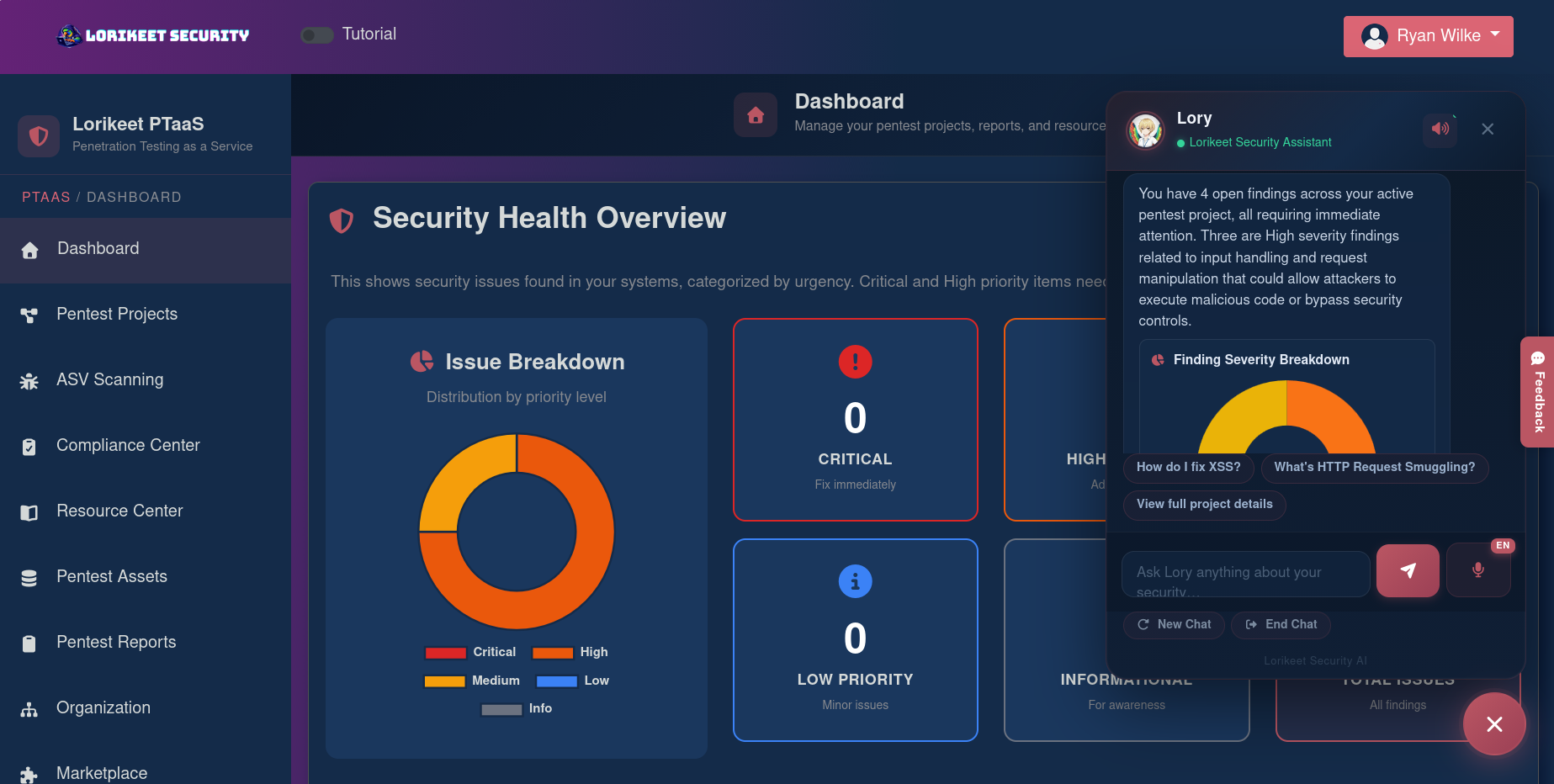
Have you ever received a 100-page penetration test report three weeks too late, only to realize your developers have already pushed ten new code deployments in the interim? For solo builders and AI leaders, the traditional "snapshot" security model is fundamentally broken because AI moves faster than a PDF can be typed. Lorikeet Security flips the script by delivering an offensive security platform that replaces static reports with a 24/7 command center for your attack surface. Bottom line: it’s the shift from reactive patching to proactive resilience, ensuring your AI agents and infrastructure aren't just "compliant," but actually secure.
The Business Case for Offensive Resilience
In the world of "One builder. One AI. Infinite possibilities," the biggest bottleneck to scale isn't the code—it’s the trust. As we lean harder into AI-driven development, the complexity of our tech stacks (think REST/GraphQL APIs, Kubernetes clusters, and LLM integrations) creates a massive, porous attack surface. Lorikeet Security addresses this by providing 100% manual penetration testing performed by human researchers, specifically targeting the "vibe coding" era where tools like Cursor and Claude Code might inadvertently introduce security debt.
From a strategic standpoint, Lorikeet offers a competitive advantage by collapsing the time-to-market for regulated industries. By acting as a Vanta and Drata partner, they bridge the gap between technical security and executive compliance. For a solo founder or a lean AI team, the ability to go from a deep-dive pentest to a SOC 2 or ISO 27001 attestation through a single platform is a massive force multiplier. It removes the friction of managing multiple vendors and allows leadership to focus on product innovation rather than chasing down auditors.
Key Strategic Benefits
- ▸Operational Efficiency: Lorikeet eliminates the "email tag" game by providing "Lory," an AI assistant trained on nearly 2,000 vulnerability entries, within a real-time portal. This allows your engineering team to get instant remediation guidance and track engagement live, rather than waiting for a post-mortem meeting.
- ▸Cost Impact: By integrating continuous attack surface monitoring and free retesting, Lorikeet prevents the "security tax" often associated with rapid scaling. You avoid the catastrophic costs of a data breach and the redundant expenses of hiring separate firms for pentesting, compliance automation, and employee training.
- ▸Scalability: The platform is built to grow with your infrastructure, covering everything from simple web apps to complex blockchain audits and IoT environments. Whether you are a solo builder launching your first MVP or a scaling enterprise managing a fleet of AI agents, the platform adapts to your specific risk profile.
- ▸Risk Factors: While the manual nature of their testing ensures zero false positives, it does require a structured schedule for deep-dive engagements. Organizations must ensure their internal dev cycles allow for the collaborative remediation process Lorikeet facilitates to get the full value of the platform.
Implementation Considerations
Deploying Lorikeet Security isn't just a "set it and forget it" tool; it’s a strategic partnership. The timeline typically begins with a scoping exercise across your entire attack surface—APIs, cloud (AWS/Azure/GCP), and even physical or social engineering vectors if necessary. Unlike automated scanners that can be noisy and disruptive, Lorikeet’s manual approach means they work alongside your team to understand the context of your AI logic.
Integration is seamless because of their partnership with compliance giants like Vanta and Drata. If you are already using these for automation, Lorikeet slots in as the professional services layer that provides the actual security "teeth" required for high-level certifications. For solo builders, the biggest change management hurdle is shifting the culture from "we’ll fix it later" to a continuous monitoring mindset. You’ll need to designate a point person to interact with the portal, though the step-by-step remediation guidance is designed to be accessible even for non-security specialists.
Competitive Landscape
When evaluating your security stack, it’s important to distinguish between infrastructure stability and offensive security. For example, while Flowtriq excels at the immediate, automated detection and mitigation of DDoS attacks to ensure server uptime, Lorikeet Security is better suited for finding the underlying logic flaws and vulnerabilities that an automated shield might miss.
Flowtriq is your frontline defense against brute-force traffic disruptions—essential for maintaining the "always-on" nature of AI services. Lorikeet, conversely, is the deep-tissue specialist that ensures your API endpoints aren't leaking data and your AI agents aren't susceptible to prompt injection or privilege escalation. While a tool like Flowtriq focuses on the availability of your service, Lorikeet focuses on the integrity and confidentiality of your entire build. Most high-growth AI startups will eventually need both.
Recommendation
Stop treating security as a checkbox and start treating it as a product feature. If you are currently preparing for a SOC 2 audit or scaling an AI app built with "vibe coding" tools, your first step is to book a demo with Lorikeet to map your attack surface. Move your security conversations out of Slack threads and into a centralized platform. For leaders, the goal is simple: achieve compliance, verify your defenses with manual testing, and get back to building.
OBJECTIVE TARGET:
LORIKEET SECURITY